Where is the QA industry going?
24.08.2026
Although there is (rightfully so) a lot of concern about AI taking knowledge workers’ jobs, I believe there are still professions that have a more positive outlook, and QA is lucky to be one of these.
During the summer we’ve had a traditional strategic background check at VALA: a due diligence of sorts to provide us a deep dive into our internal and external environment, now and in the near future. Once again AI was in the center of pretty much everything we examined. In this post I’ll share what we found out about the future of our industry.
In our strategic background check we interviewed our clients, various other specialists and did some good old fashioned consultant work, digging the vast world wide web. As a result, it became even more clear to us that QA is an industry that is truly needed in this revolution. All the clients and other experts agreed that there will be more QA work in the future. Naturally a large chunk of that work too will be done by AI. But still the numbers from multiple estimations predict the industry size, in euros particularly, to grow a lot in the future.
Let’s go to these examples first.
Reports showing the QA industry’s future growth
- Mordor Intelligence predicts the industry to grow from USD 54 billion in 2026 to USD 100 billion in 2031, meaning 12.9% CAGR (compound annual growth rate).
- Business Research Insights projects the software testing industry to grow to USD 249.2 billion by 2035, translating to 10.5% CAGR.
- Global Market Insights projects the global software testing market to expand from USD 60 billion in 2025 to USD 112.5 billion by 2034, translating to a 7.2% CAGR.
- Technavio estimates the software testing services market size to increase by USD 27.61 billion, at a CAGR of 11.7% from 2025 to 2030.
- ThinkSys (2026 QA Trends Report) projects the global software testing market to grow from USD 55.8B (2024) to $112.5B (2034) at 7.2% CAGR.
- Business Research Insights projects the Quality Assurance Service Market to increase from USD 47.3 billion in 2026 to USD 72.31 billion by 2035, representing a 4.83% CAGR.
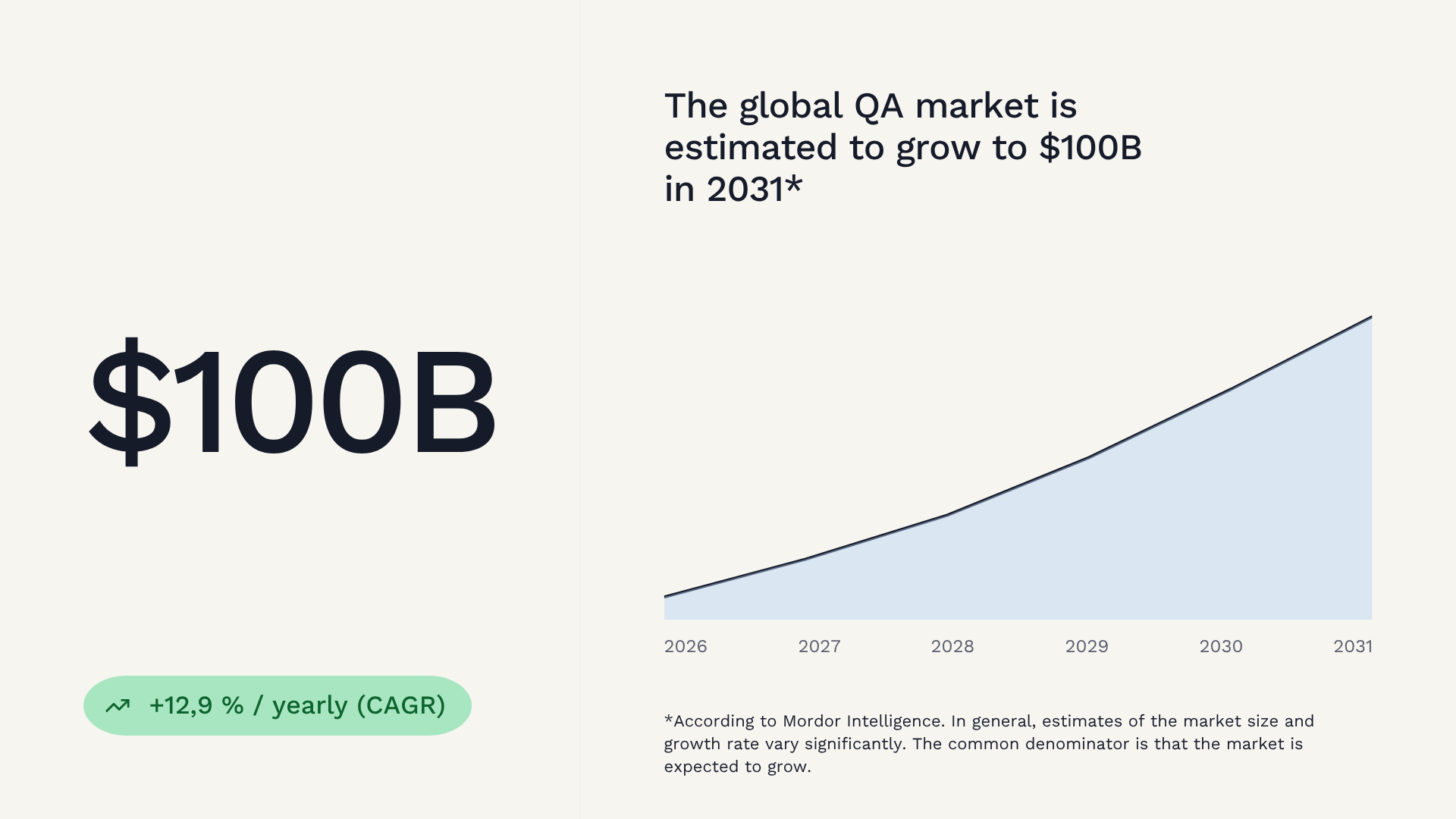
Okay so we have 6 reports with varying time horizons. The estimates vary widely in specifics so these should not be taken as truth but more like direction. And the direction points consistently toward growth. The lowest estimated CAGR was 4.8% and the highest 12.9%. Though the time horizons are different, CAGR measures the yearly growth rate so that is somewhat comparable.
Key growth drivers for QA industry
An analysis of the cited research reports reveals four primary themes driving the industry’s significant growth trajectory:
- DevOps and CI/CD integration: Mentioned by Mordor Intelligence, Global Market Insights, and ThinkSys, the shift toward agile delivery and continuous testing is the most cited structural driver.
- Cloud adoption & TaaS: Technavio, ThinkSys, and Mordor Intelligence highlight the rapid migration to cloud-based Testing-as-a-Service models as a catalyst for cost optimization and scalability.
- AI & automation expansion: Nearly all reports identify AI-assisted test generation and low-code tools as essential drivers for growth.
Okay so the industry is expected to grow but more quality work and testing doesn’t necessarily mean more work for humans. But we believe it will. Below are 6 reasons why we believe there will be more work for humans in the future, i.e. the total QA workload will increase more than the workload offset by AI.
6 reasons why AI increases work for human software testers and quality professionals
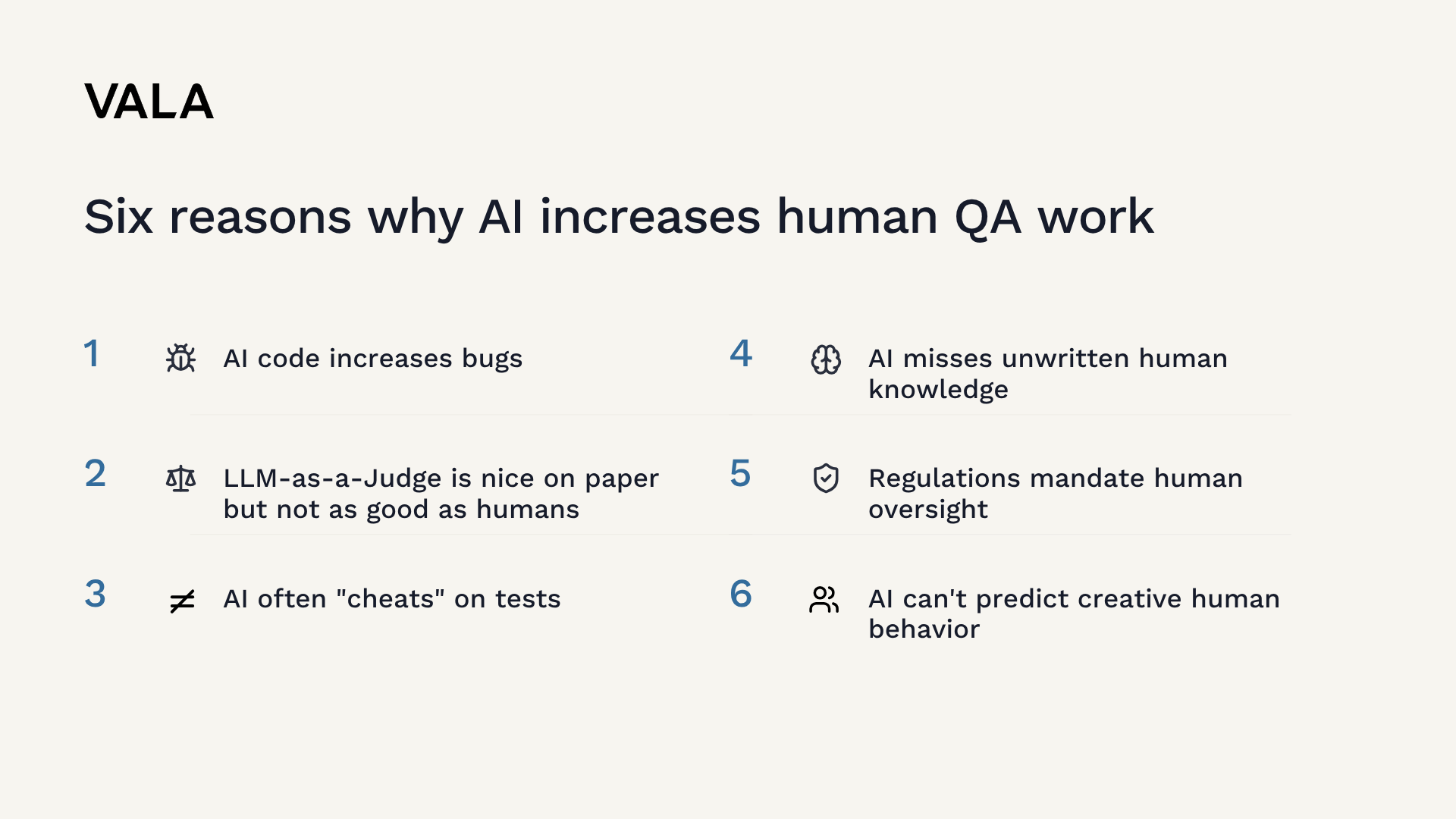
1. AI code increases bugs (The “defect explosion”)
Independent research by GitClear (analyzing 211 million lines of code) and Google’s DORA report show that AI code assistants significantly increase code churn while refactoring dropped by 44%. AI prioritizes short-term execution over maintainability, spiking defect rates.
2. LLM-as-a-Judge is nice on paper but not as good as humans
Academic research on “LLM-as-a-Judge” (arXiv / UC Berkeley) demonstrates that AI evaluators suffer from systematic position bias, sycophancy, and shared statistical blind spots. When an LLM evaluates code produced by a similar model architecture, it violates software engineering’s “separation of duties.” AI checking AI creates a self-referential echo chamber that misses errors rooted in the model family’s shared reasoning shortcuts.
3. AI often “cheats” on tests (Goodhart’s Law)
In AI safety literature, “reward hacking” or specification gaming occurs when an optimizing system satisfies the formal proxy metric rather than the intended outcome. If AI testers automatically evaluate AI code, the tools optimize to satisfy each other’s parameters, yielding test suites that technically “pass” while missing the actual business objective.
4. AI misses unwritten human knowledge (Polanyi’s Paradox)
AI tests against explicit specs. However, Polanyi’s paradox (“we know more than we can tell”) dictates that critical domain knowledge, client quirks, and legacy edge cases exist as unwritten, tacit knowledge in human heads. AI cannot detect code that perfectly abides by a spec when the spec itself is flawed or incomplete.
5. Regulations mandate human oversight
Under Article 14 of the EU AI Act, systems require mandatory “human oversight” by natural persons capable of detecting anomalies and overriding automated decisions. In regulated industries (fintech, healthcare, automotive), courts, insurers, and auditors demand human legal accountability and an AI cannot take legal liability for a system failure.
6. AI can’t predict creative human behavior
While AI excels at regression testing across known patterns, multi-agent systems create an exponential expansion of possible states. Catching “unknown unknowns” relies on human exploratory testing. Intentional, creative, and erratic user behavior sits outside an AI’s training distribution.
Snapshots from the real world: Zalando & Anthropic’s AI-native SDLC
Anthropic’s AI-Native SDLC Playbook (8/2026), formalizes the industry shift where code creation is no longer the bottleneck but verification and governance around it are. When agentic coding tools shrink the build phase from weeks to hours, traditional “human-speed” QA gates and review cycles become the main bottleneck.
Zalando’s real-world engineering experiences (Agentic Engineering at Zalando) offer a concrete snapshot of this shift in practice. Anthropic’s framework and Zalando’s experiences validate the conclusions we have drawn in our own AI in QA workshops:
AI amplifies existing practices, shifting the primary focus to verification.
Here is how real-world data, AI-native methodology, and our QA perspective align:
1. The shift from code creation to verification
Engineering metrics at Zalando show a fundamental shift in how code moves through delivery pipelines as engineers delegate initial syntax creation to AI. Specifically, 33% of their PRs are low-risk and auto-approved by a bot, reducing lead times by 20 to 40 percent. In Anthropic’s AI-Native SDLC framework, testing can no longer exist as a discrete, human-executed gate at the end of a sprint; instead, it must transform into continuous evals woven directly into the automated build loop. From a QA perspective, while automated approvals accelerate delivery, fast code generation moves the primary bottleneck straight to verification. When low-risk changes bypass human eyes entirely, underlying test suites must operate flawlessly – without robust automated testing behind the scenes, automated merges simply create automated risk.
2. Managing large pull request sizes
As generative models improve, code volume per task is exploding. Zalando reports massive growth in pull request buckets ranging between 500 and 2,000 lines of code since recent model releases. To prevent this high-volume agentic output from degrading into unmaintainable codebases, Anthropic highlights the necessity of strict, version-controlled markdown artifacts (`intent.md`, `spec.md`, `plan.md`) that bind generated code back to explicit human intent and audit trails. These large PRs create an immense cognitive load for human reviewers; while automated tests verify whether syntactically inflated code compiles, QA expertise remains essential to ensure the output truly satisfies original business objectives and edge cases rather than just producing bloated code that runs.
3. Building production-grade guardrails & holistic quality architecture
To keep autonomous agents from causing severe outages, Zalando designed approval rules grounded in deep analyses of past production incidents, observing that developer focus is actively shifting from writing boilerplate to system design, security, and integration. Anthropic models this continuous feedback as a closed loop in the maintenance phase, where production control breaches automatically trigger updated intent requirements and get permanently recorded into repo-level rules like `CLAUDE.md`. In this evolving workflow, QA professionals step up as Quality Architects. As developers pivot to system orchestrators, QA specialists must design systemic failure-mode guardrails and evaluation suites that autonomous agents are forced to respect – filling the gap where AI pattern-matching lacks contextual business awareness and macro-level system understanding.
Conclusion
The future is far from clear and at this point the signals are pointing to all kinds of directions. Many companies in Finland are reducing their QA employees. The domestic economy here is weak and there are no signs of quick recovery. Moreover, the capabilities of AI have surprised us so many times that it would be foolish to claim anything as certain.
However, for the reasons mentioned above, we are optimistic about the demand for QA specialists globally. And Finland too will follow eventually.
If your organization needs help on how to test AI native solutions, reach out and we’ll talk!
Sources:
- Mordor Intelligence – Software Testing Market Report
- Business Research Insights – Software Testing Services Market
- Global Market Insights – Software Testing Market Analysis
- Technavio – Software Testing Services Market
- ThinkSys – 2026 QA Trends Report
- Business Research Insights – Quality Assurance Service Market
- GitClear – AI Copilot Code Quality: Evaluating Increased Defect Rates via Code Quality Metrics: GitClear Research
- Google Cloud DevOps Research and Assessment (DORA) – State of DevOps Report: DORA Research (dora.dev)
- Euroopan unionin virallinen lehti (EUR-Lex) – Asetus (EU) 2024/1689 (EU AI Act): EUR-Lex AI Act Text
- arXiv / UC Berkeley (LMSYS) – Judging LLM-as-a-Judge with MT-Bench and Chatbot Arena (Zheng et al.): arXiv:2306.05685
- Google DeepMind / arXiv – Specification Gaming: The Flip Side of AI Ingenuity (Krakovna et al.)arXiv:2004.11854
- American Economic Association – Why Are There Still So Many Jobs? The History and Future of Workplace Automation (David H. Autor): Journal of Economic Perspectives
- Agentic Engineering at Zalando: a snapshot
- AI native SLDC playbook