What test automation actually returns in Salesforce transformations
21.06.2026
Every Salesforce transformation has a QA line item. Very few teams can answer the simple CFO question: what do we get back for it?
The usual answers like bugs found, coverage percentage or test count measure activity, not value. They tell you what QA is doing but not whether any of it is worth the money. In our experience working on large Salesforce transformations, the teams that can’t answer this question tend to underinvest in QA, overinvest in UAT, and still end up explaining the same production incident to the same executive three quarters in a row.
The real return on test automation is somewhere else. And in Salesforce specifically, it compounds in ways that don’t compound in other environments.
The four metrics that actually matter
If you measure only coverage and test count, you will get more coverage and more tests. Neither correlates with business outcomes. What does correlate is:
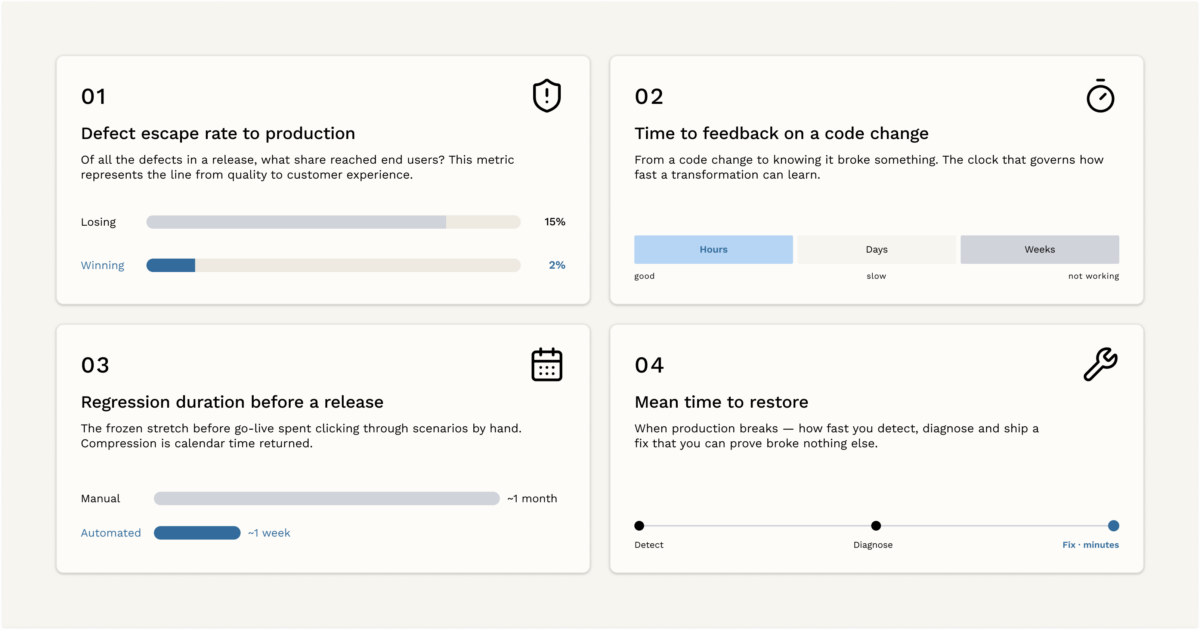
Defect escape rate to production. Of all the defects that existed in a release, what fraction reached end users? This is the number that connects quality investment to customer experience. A team with 80% code coverage and a 15% escape rate is losing. A team with 60% coverage and a 2% escape rate is winning.
Time to feedback on a code change. When a developer makes a change, how long until they know whether they broke something? Hours is good. Days is bad. Weeks means automation isn’t doing its job. Feedback speed is the clock that governs how quickly your transformation can learn.
Regression duration before a release. How long is the last stretch before go-live, where nothing can change because someone is manually clicking through scenarios? For teams with poor automation, this is a month. For teams with strong automation, it is a week. That compression is calendar time returned to the business.
Mean time to restore. When something goes wrong in production, how fast can you detect it, diagnose it, and push a fix? This is where an automated test suite earns its keep in an incident, you can verify the fix didn’t break anything else in minutes.
None of these show up in a weekly QA status report that counts tests executed. All of them show up on the income statement, eventually.
Why the return compounds in Salesforce
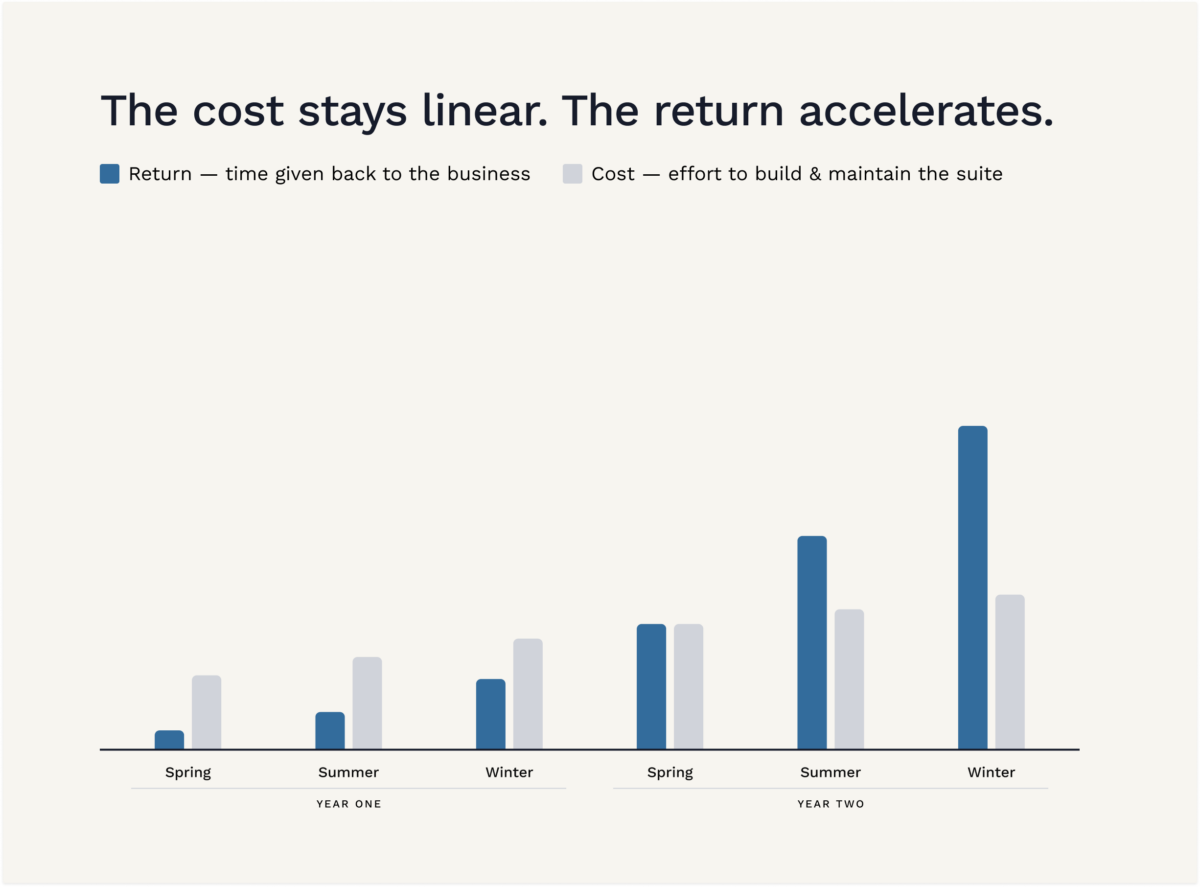
Salesforce ships three major platform releases a year. Spring. Summer. Winter. Each has the power to rearrange the DOM, change how Lightning components render, or quietly shift an API behaviour. On top of that, your own team is shipping changes: new fields, new flows, new integrations, new record types.
Every one of those changes is a potential regression. In a project without test automation, verifying that nothing broke means someone, manually, running through every critical business flow. For a mid-sized Salesforce implementation, that’s weeks of work. For a large one, it can be months, and it gets repeated every time.
With automation, that same verification runs in an afternoon, and it runs every day without asking. The difference is not incremental but more like “we regression-test before a release” and “we regression-test continuously.” The first is a gating activity that eats time and the second is a background hum that frees it.
This compounding is why Salesforce test automation has an economic profile that other investments don’t. The cost is roughly linear with scope. The return accelerates with every release cycle you stop re-doing by hand.
The cost of not investing
The hidden half of the business case is the cost nobody wants to put in a slide.
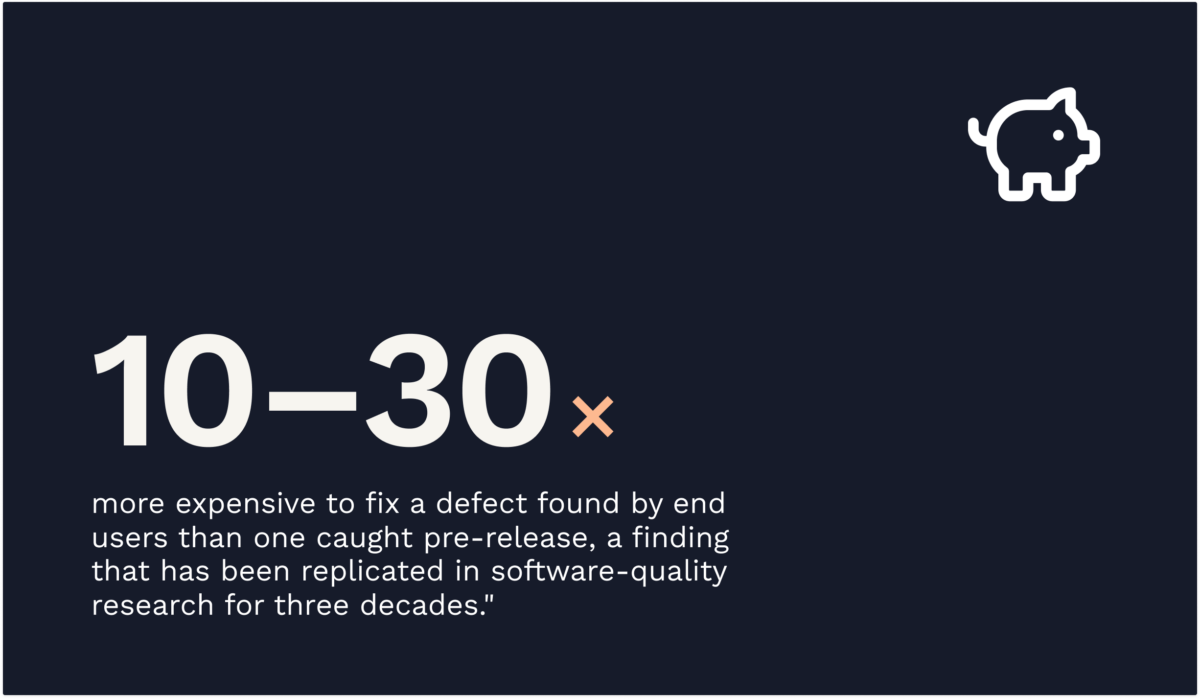
Production defects found by end users cost ten to thirty times more to fix than defects caught pre-release. That number isn’t a consultant’s rule of thumb – it has been replicated in software quality research for three decades. The reasons are concrete: production incidents pull in senior engineers, cause customer support volume, require emergency change windows, and damage trust.
Release delays tie up license spend, consultant day rates, and business roadmap capacity. A Salesforce transformation that slips by a quarter is a quarter of salaries, contractor fees, and deferred business value that the organization absorbed for nothing.
And then there is the less quantifiable cost: the cost of fear. Teams that don’t trust their tests don’t trust their changes. Releases get smaller and less frequent. New features wait. Refactoring stops. The platform ages into a configuration museum because no one is willing to touch it.
None of this appears in a QA budget. All of it appears somewhere else. The job of the business case for test automation is to make that reallocation visible.
Where AI fits, and where it doesn’t
AI is changing what is possible in test automation. It drafts tests faster. It triages flaky failures. It generates test data. It analyses patterns across thousands of test runs in ways that no human could.
But AI does not close a foundational gap. If your team does not know what to test, AI will help you test the wrong things faster. If your test architecture is weak, AI will scale that weakness. If you have no assertion discipline, AI will write tests that pass and prove nothing.
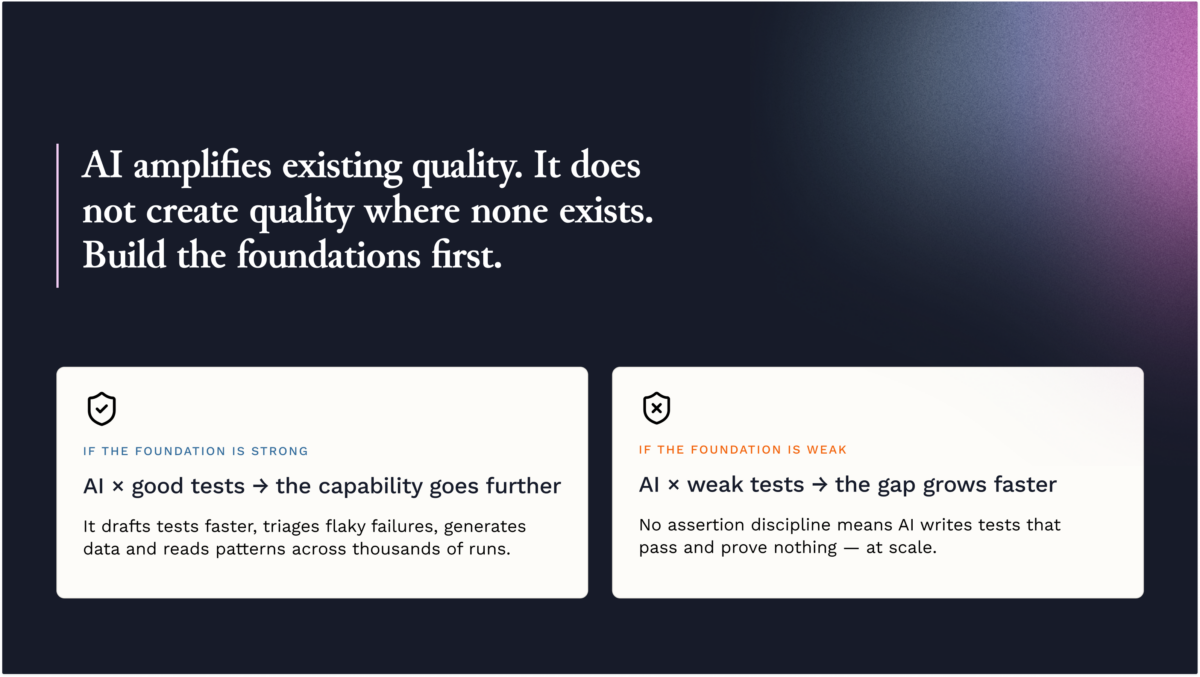
AI amplifies existing quality. It does not create quality where none exists.
The implication for a Salesforce test automation investment is specific. Before asking how do we make AI write our tests faster?, ask are the tests we already have proving what we need them to prove? If the answer is yes, AI will make that capability go further. If the answer is no, AI will make the gap grow faster than the capability.
What to measure?
If you are evaluating an existing Salesforce QA investment, start with one question: what was our defect escape rate last quarter?
If no one can answer, you have found the place to start. Not because escape rate is the only metric, but because it is the one that forces the organization to track outcomes instead of activity. Once you are tracking it, the conversation changes. Coverage becomes a means to an end. Tests become an investment with a measurable return. And the CFO question – what do we get back? – becomes one you can answer with numbers, not adjectives.
The return on Salesforce test automation is real, compounding, and specific to the platform. It just isn’t visible in the metrics most QA reports track. Change the metrics, and the return becomes impossible to miss.