Trust is the most important quality of data: why data pipeline QA is more critical than ever?
09.02.2026
The significance of data in business decision-making is no longer just a trend, it is a lifeline. As companies look more towards artificial intelligence and machine learning, it is good to remember one basic rule: AI is exactly as smart as the data fed to it. If the underlying data is nonsense, the results will be nonsense too.
But how do we ensure that massive amounts of data remain high quality as they travel through complex processes? The answer lies in systematic quality assurance of data pipelines and ETL processes (Extract, Transform, Load).
When data changes form, the risk of error grows
A data pipeline is like a modern factory line. Data is collected from different sources, cleaned, combined, and modified before it is stored in a data warehouse for analysis. Every one of these stages, meaning extraction, transformation, and loading, is a critical point where the correctness of the information can be put at risk.
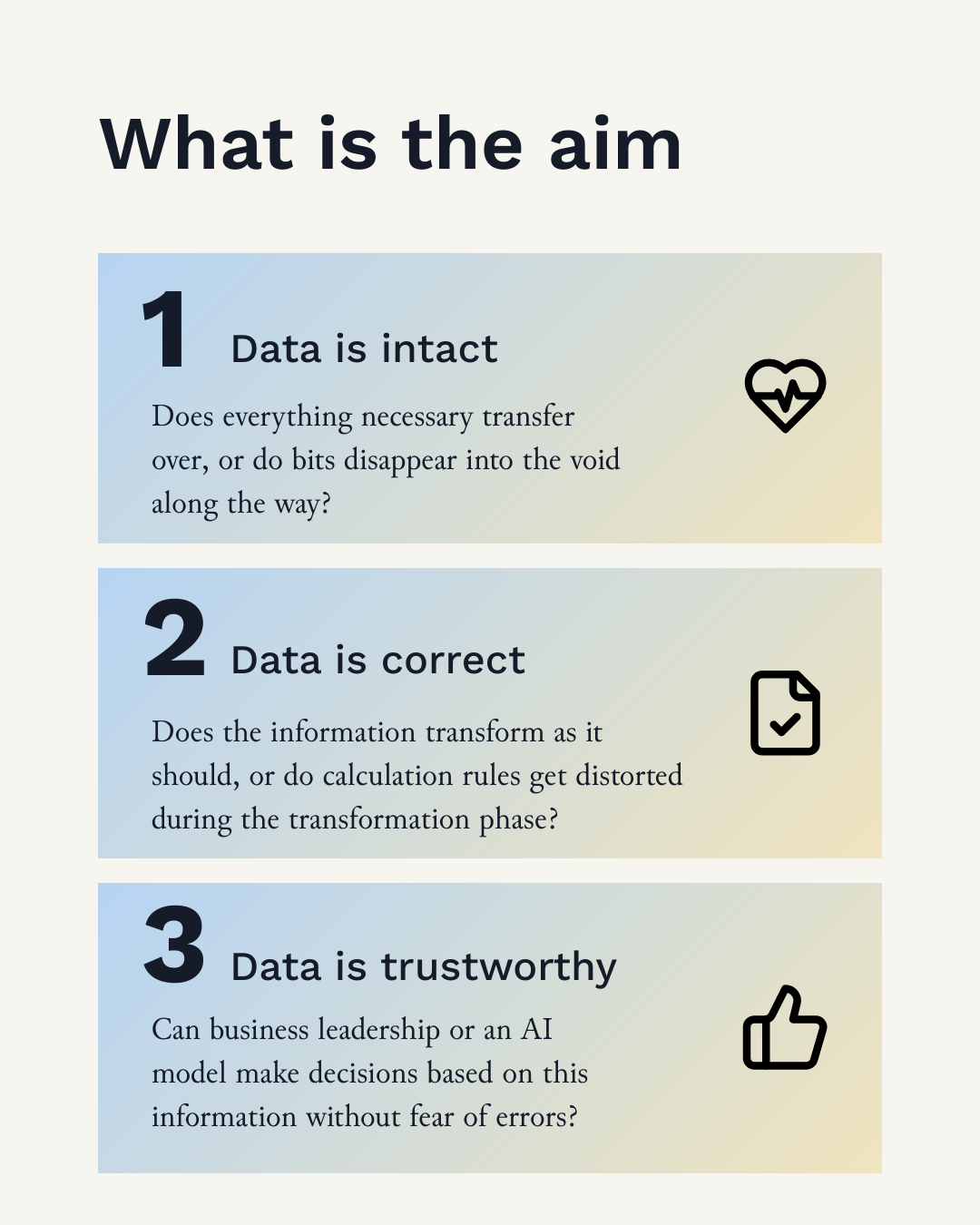
Quality assurance of data pipelines aims to ensure that:
- Data is intact: Does everything necessary transfer over, or do bits disappear into the void along the way?
- Data is correct: Does the information transform as it should, or do calculation rules get distorted during the transformation phase?
- Data is trustworthy: Can business leadership or an AI model make decisions based on this information without fear of errors?
Case S-Pankki: When quality is at the core of operations
At VALA, we have worked deeply with data quality assurance with S-Pankki, among others. In the major business transaction between S-Pankki and Handelsbanken and the related migration, it wasn’t just about numbers. It was about the daily lives of hundreds of thousands of customers, including their accounts, cards, and investments.
In a scale like this, there is no room for error. We were involved in ensuring that the data transferred intact and in the correct format to its new home. It was particularly critical to test that data warehouses and regulatory reports functioned exactly right after the transfer. This required not only technical skills but also an understanding of how data links to business continuity and customer satisfaction.
As Henri Tehilä, QA Manager at S-Pankki, noted, quality assurance has a direct connection to the brand and trust. When you can trust the data, the organization can focus on creating value instead of just checking numbers.
Read more here: https://www.valagroup.com/references/s-pankki/
How to get started?
Data pipeline quality assurance is not just a final inspection; it should be an integral part of development from the start. It includes, among other things:
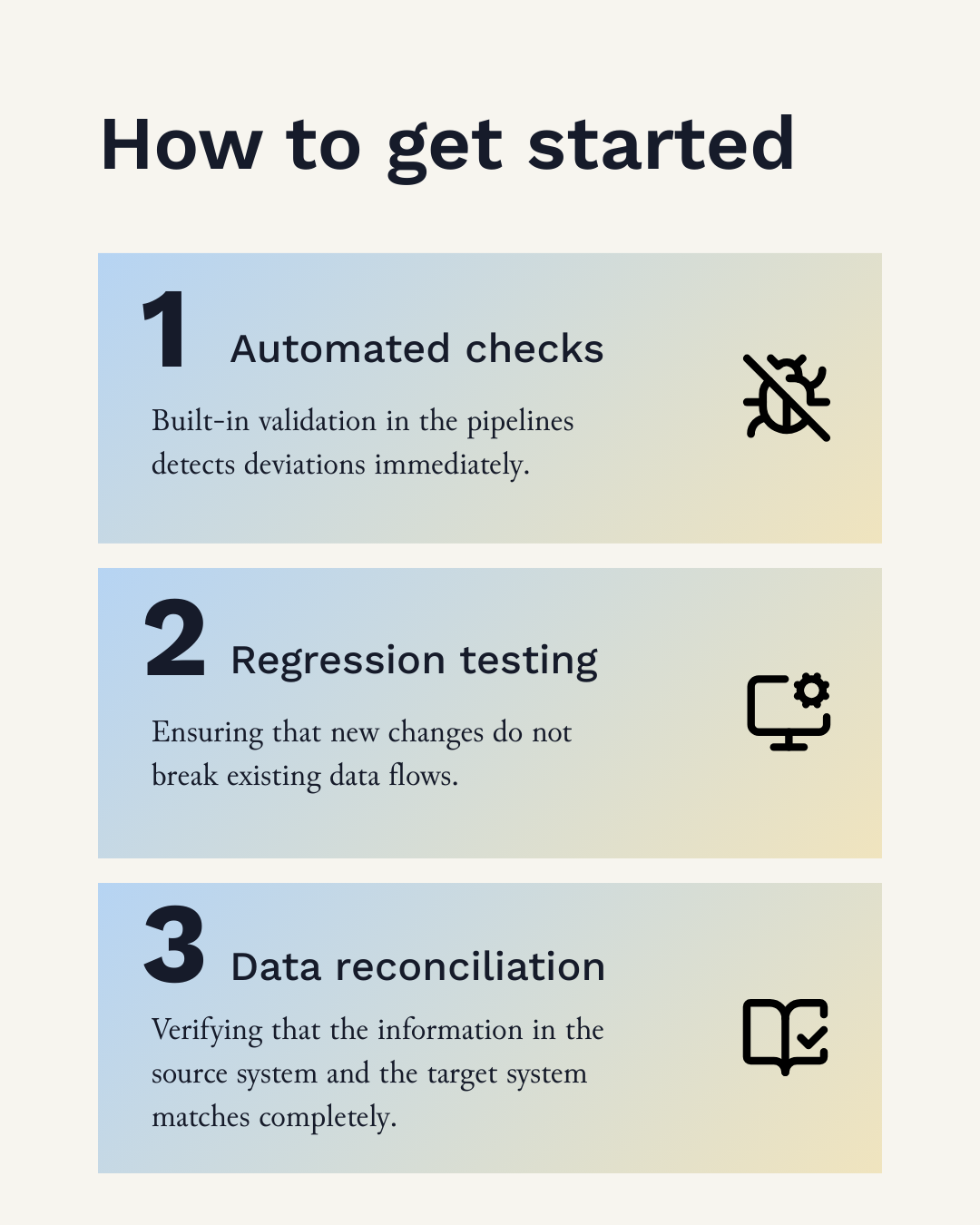
- Automated checks: Built-in validation in the pipelines detects deviations immediately.
- Regression testing: Ensuring that new changes do not break existing data flows.
- Data reconciliation: Verifying that the information in the source system and the target system matches completely.
Quality is the safety net for innovation
In these times, new technologies and tools are born at a fast pace, and organizations are eager to adopt them. Often in this speed, quality assurance is forgotten or seen as secondary. In reality, it is the opposite.
When data pipeline QA is handled properly, it creates a safety net for new experiments and innovations. When the foundation is in order and automated checks alert us to errors, we dare to test new tools and AI models much more boldly.
Quality assurance is therefore not a hindrance to innovation, but its necessary foundation.
Summary
Data solutions are the nervous system of a company. If wrong information travels through the nervous system, the whole organization reacts incorrectly. By investing in data pipeline quality assurance, you build a solid foundation upon which it is safe to build both traditional reporting and future AI solutions.
Do you want to talk more about how to make your organization’s data pipelines withstand critical scrutiny? We at VALA are happy to help, whether it’s about complex migrations or continuous quality assurance.