Testing assembly 2025 after talk summary
15.12.2025

We recently gathered at the VALA office for our annual Testing Assembly After talk. While industry events are fantastic for inspiration, they sometimes present a polished, “headline-driven” view of software development. Our goal for the evening was to scratch beneath that surface, process the insights on a deeper level, and translate conference talks into concrete realities for our work.
Whether you missed the event or were there and want to hear our perspective, here are VALA’s key takeaways from Testing Assembly 2025.
The reality check: Acknowledging the pain of change
A recurring theme in our discussions was the stark contrast between polished case studies and the messy reality of implementation.
Presentations from major players like Nordea and Ponsse were fascinating, while they still left us debating the unseen work, calendar time, and sheer effort required to achieve those results. For us, it highlighted the need to better frame client expectations, transformation rarely looks as smooth in practice as it does on a slide deck.
This is why Ari Laitinen’s presentation from OP resonated so strongly. He brought much-needed realism to the stage, being honest about the “pain and struggle” on the path of change (relating to AI), while still outlining a clear future plan.
Beyond the big-picture case studies, two sessions provided immediately actionable insights on the human element of testing.
Concrete learnings: Mindset and metrics
1. Cultivating the explorer’s mindset
Alexandra Schladebeck’s keynote was packed with insightful challenges to traditional thinking. One of us noted Schladebeck’s emphasis on testing as a continuous learning process, you must evolve your testing based on input you’ve already received.
A standout moment was her suggestion to ask stakeholders: “How do I disappoint you?” The purpose of this provocative question is to remember that testers aren’t there to please people; we are there to do a job and raise uncomfortable issues.
2. Why metrics fail (and how to fix them)
One VALA person highlighted excellent practical advice from Veli-Matti Ahlroth on making quality metrics valuable. Ahlroth pointed out a common failure pattern: trying to force adoption on an entire organization at once.
Instead, he suggested focusing on activating the “experimenters” in the team (roughly 18%) to participate in metrics gathering. You cannot win over the 64% “wait and see crowd” – who require proof that the metrics bring value – without the support of those early adopters first.
AI in practice: From hype to hands-on
AI was naturally a major topic, but the value varied between high-level hype and practical application.
The highlight for many of us was again Ari Laitinen from OP, who provided a practical demonstration of how they have trained a language model for their specific needs. This hands-on approach generated great interest, and we hope to see more practical sessions like this in the future.
Other sessions, like Michael Slezak’s talk on using AI with Playwright, moved incredibly fast. While impressive looking, it was hard to grasp the substance in the moment. However, a concrete takeaway from the AI track was a book recommendation that is already circulating among VALA people: “The Art of Prompting: Mastering the Language of Artificial Intelligence.”
Days last performance: Katri Saarikivi and building high quality interaction
Katri Saarikivi’s presentation was a brainstorming session about change, empathy and learning and taking the tour in the future. Katri elaborated very much about the human brain’s ability to learn new things and how communication can make us better human beings. Katri pointed out that curious minds tend to have more ability to discover new things and that is why it is important to keep the mind of the child within us always wherever we go. Katri also pointed out that we humans have always had the ability to adapt to new kinds of circumstances and that is how we have survived for so long. What was underlined in her presentation was empathy as a driving force which leads to learning. Keypoint in her presentation was: we’re going to have a good and bright future if we’re able to learn from the old learnings and learn new things with new technology.
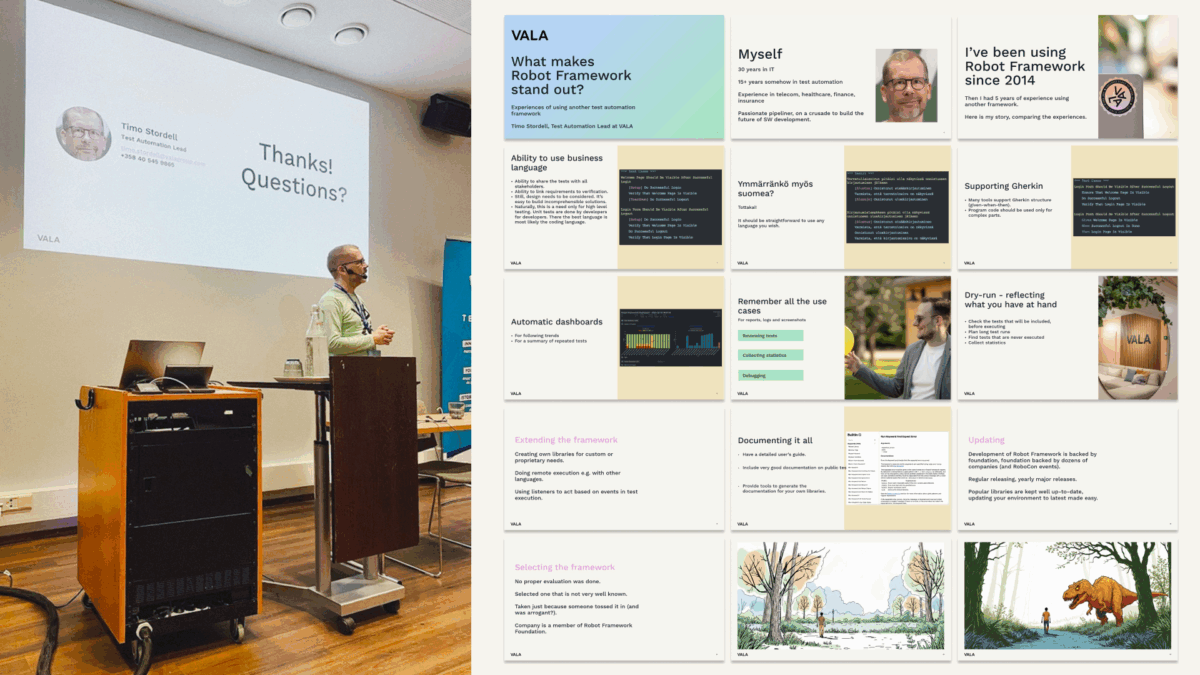
VALA on stage
We were incredibly proud to see our own Timo Stordell take the stage. Rather than just a generic tool talk, Timo delivered a deep dive into the characteristics of a good acceptance testing framework. He used Robot Framework as a strong example, comparing it against another solution that failed to meet real-world needs. It was a strong, pragmatic presentation rooted in actual experience.
Link to the presentation slides
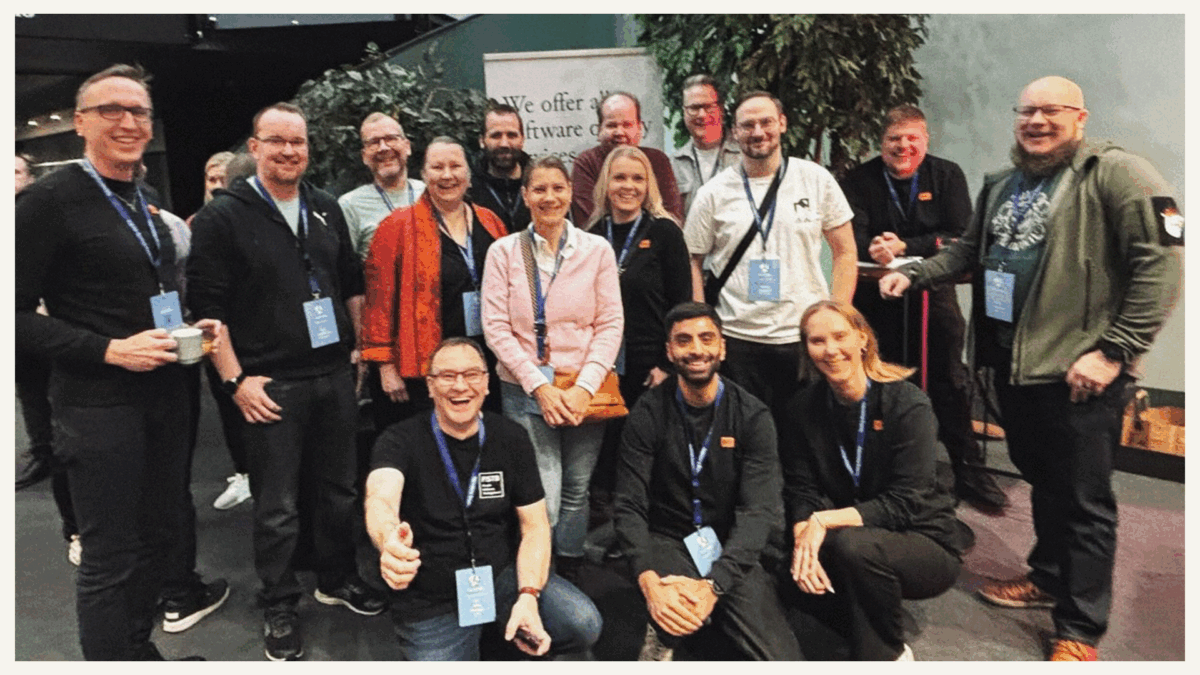
Final thoughts on the event day
The event itself was busy, noisy, and at times overwhelming due to the cramped venue spaces. While it is special for us to meet quality enthusiasts and for many, this is the most important aspect of the seminar, this is still something we believe could be developed in the future. While the technical track didn’t offer groundbreaking new information for our most senior professionals, the day was definitely a net positive.
The keynotes, delivered by highly talented experts deeply immersed in their respective fields, brought tremendous energy to the day. In the latter keynote empathy and learning were in the core, deepening our understanding with the (three) dimensions of empathy. As the information was heavily science-based and clear as well as aligned with the values at Vala, it was a perfect finish for a conference day. Ultimately, however, the best part of Testing Assembly remains the human element: reconnecting with old colleagues and sparking discussions that continue well into our office Aftertalks.