Test Automation Trends 2026: By RoboCon 2026 attendees
16.03.2026
In February at RoboCon, we ran a short survey about test automation trends.
65 testing professionals from around the world answered.
This is not a large academic study but a useful snapshot from people who work with test automation every day. In the survey we asked people’s opinions on trends for test automation in 2026, and separately for a longer time period 2026-2030. People could select multiple options, so the percentages don’t add up to 100%.
In this post we’ll first take a look at the results briefly and then analyze them a bit more, let’s get to it!
What people picked for 2026
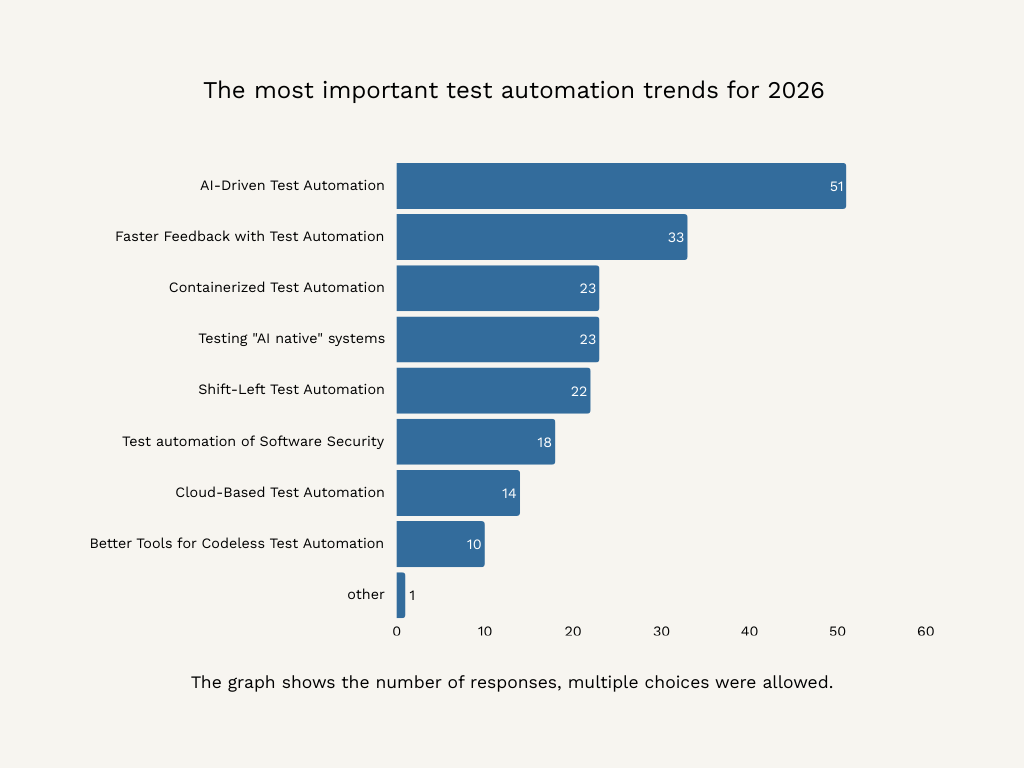
The clear number one trend for 2026 was: AI-driven test automation (78.5%).
After that, the answers point to a few clear themes:
Faster feedback and smoother delivery
- Faster feedback with test automation (50.8%)
- Shift-left test automation (33.8%)
More stable execution environments
- Containerized test automation (35.4%)
- Cloud-based test automation (21.5%)
New targets and new risks
- Testing AI-native systems (35.4%)
- Security test automation (27.7%)
Codeless tools were less of a focus:
- Better tools for codeless test automation (15.4%)
What people picked for 2026 to 2030
For the longer term, people expect automation to become more independent, and they expect the systems to change:
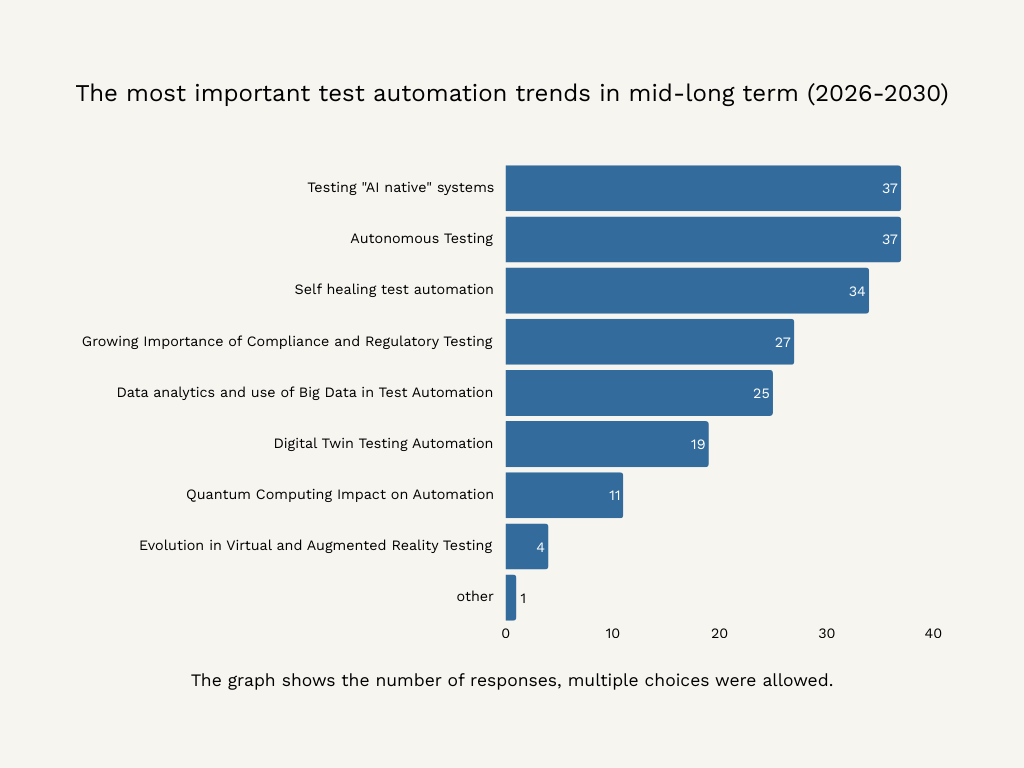
- Autonomous testing (56.9%)
- Testing AI-native systems (56.9%)
- Self-healing test automation (52.3%)
- Compliance and regulatory testing becomes more important (41.5%)
- Data analytics / Big Data in test automation (38.5%)
Some “future tech” topics were present too though not getting as many “votes” as the others. Digital twins was surprisingly high considering it’s mostly for embedded environments:
- Digital twins (29.2%)
- Quantum computing impact (16.9%)
- VR/AR testing evolution (6.2%)
What we think this means
1) People are chasing AI
“AI-driven test automation” is not just one trend among many. It is the trend. In the results and in real life, AI appears in two ways: AI assisted/powered testing, and AI as something we must test in the product.
That also matches what we see in real life: leaders want to know how AI can help their teams. Sometimes the request is simply “we need to use AI in QA, tell us how and where”.
2) But the second message is: people need faster confidence
The next most popular trend was “faster feedback”. Containerisation and shift-left also scored high.
That tells us that people want AI, but they do not want AI for decoration.They want less waiting, less manual work, and less chaos in feedback loops.
3) “Self-healing” and “autonomous testing” are a response to maintenance pain
It’s a real pain to keep thousands of tests alive while the product changes.
Self-healing and autonomous testing are basically hopes that:
- tests break less
- automation needs less babysitting
- teams get signals they can trust
This will only work if we have a clear idea of what “correct” means. Otherwise “self-healing” becomes “self-changing”.
4) AI-native systems change what “testing” even means
More and more products include LLM features, agent workflows, or AI-based decision logic.
These systems do not behave like classic deterministic software:
- output can vary
- quality is sometimes about “is it safe and useful”, not just “is it correct”
- failures can be trust failures
That is why “testing AI-native systems” rises so high in the 2026 to 2030 list. Different kinds of skills, knowledge and mindset are needed from tomorrow’s quality specialists. At VALA we like to talk about evalOps which means “Continuous evaluation practices that monitor, measure, and improve Al system quality across development and production to ensure reliable, safe, and business-aligned outcomes.” This change will be big to say the least. Less script-writing, more planning, evaluation, monitoring, and risk thinking.
5) Compliance is coming into QA work
Compliance and regulatory testing was the 4th most mentioned longer-term trend.
This fits the story we are telling our clients daily. First of all there is more regulation overall, and secondly AI powered development ushers this. When humans write most of the code, the development process itself gives you a lot of implicit control. But when AI writes a big part of the code, those natural controls weaken:
- changes can become larger and faster
- the “why” behind a change is often unclear
- the same prompt can produce different code tomorrow
- teams can ship things they do not fully understand yet
So QA has to fill the gap. Not by “testing more clicks”, but by adding evidence and control around changes.
Closing thought
AI is clearly the big trend. The survey confirms it though it didn’t need confirming.
But AI will not remove the hard work of quality. It will move the work.
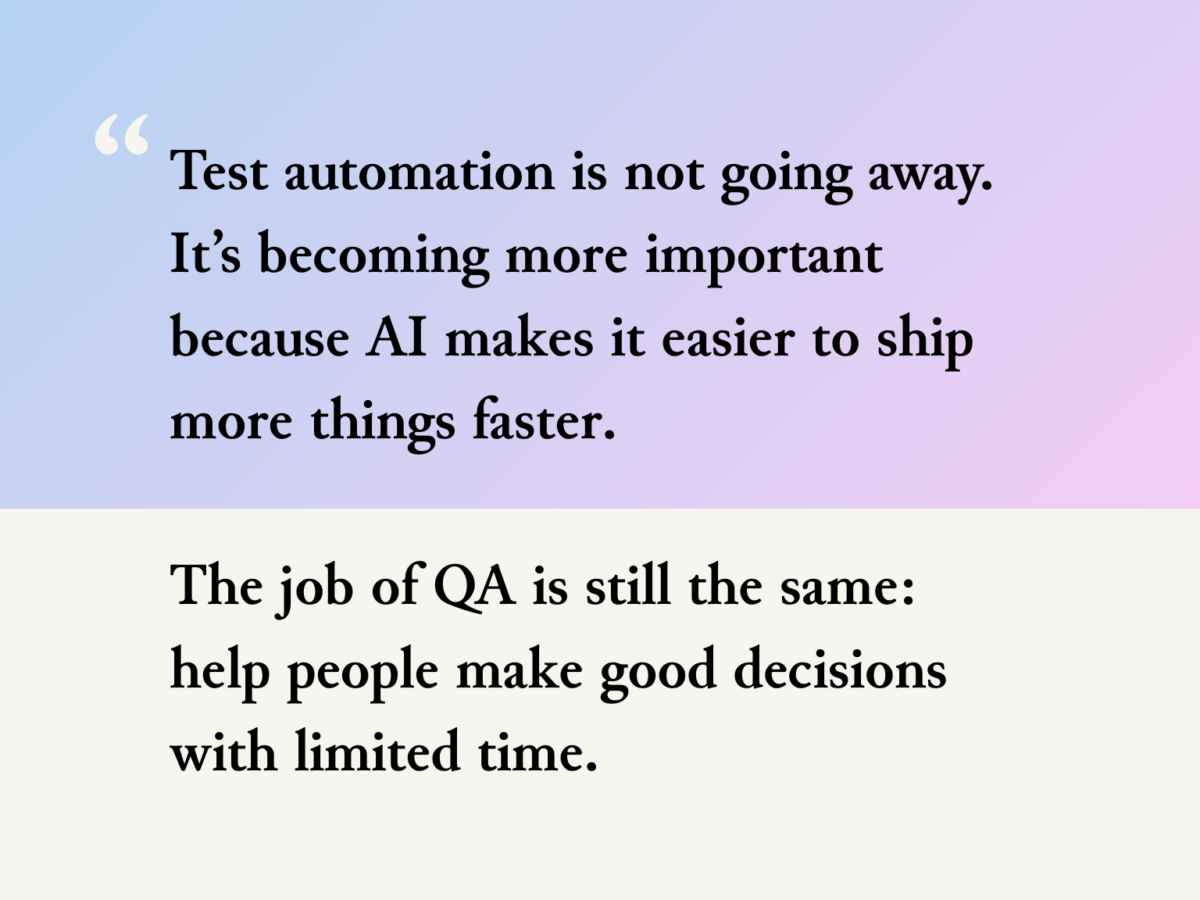
More code and more features will ship faster, so testing and QA becomes more important than ever.
- Blog
- Software testing